

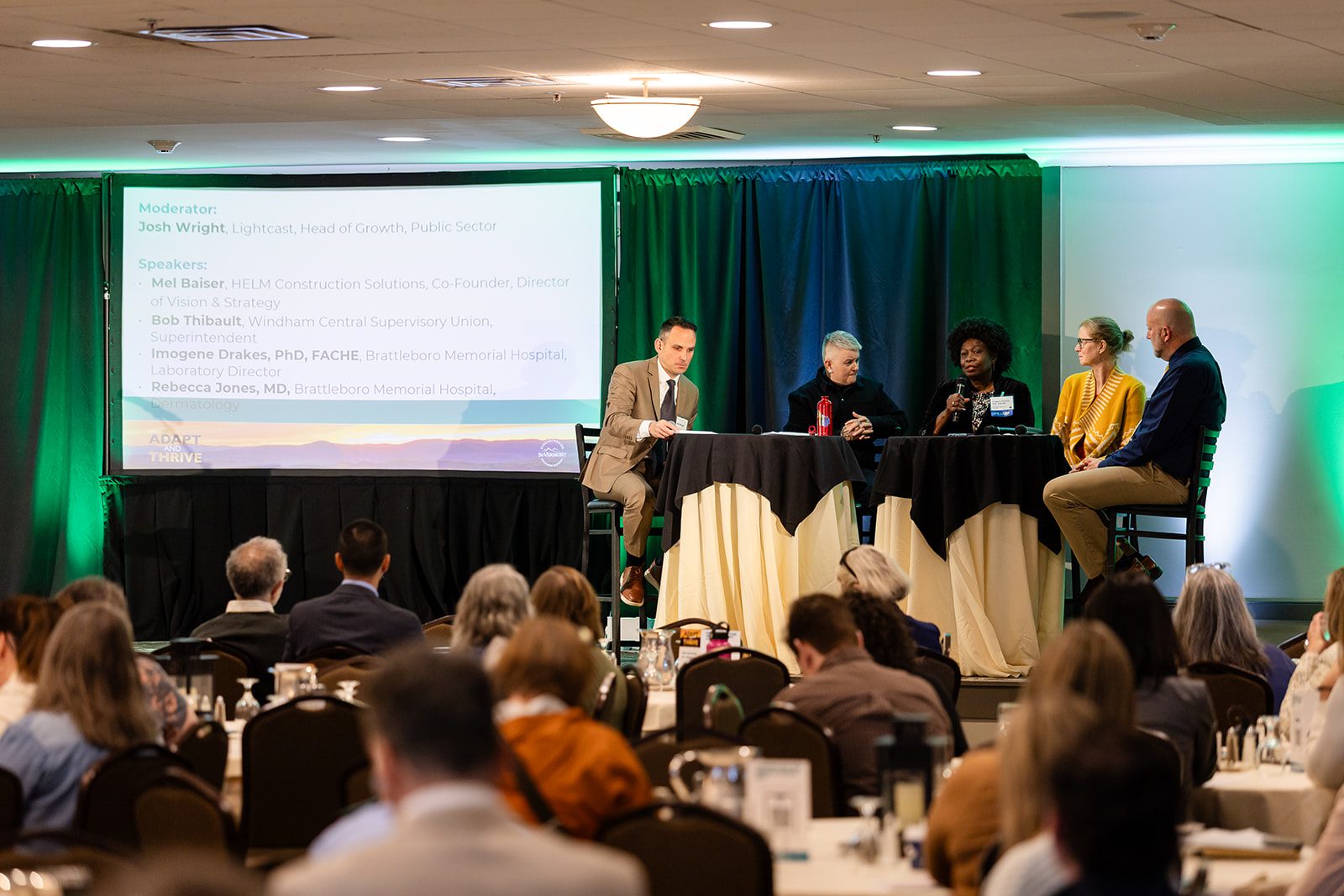

People listening to a panel

WELCOMING WORKPLACES

HIRING NEW AMERICANS

BDCC’s “Welcoming Workplaces” programing helps employers attract, retain and support an increasingly diverse workforce.

BDCC provides trainings and workshops to help employers lean into a changing workforce and employment environment. Recent programs include programming sponsored by the Vermont Community Foundation and delivered with nuwave consulting the Expand Your Talent Options Series in partnership with BAHRN; and a 2025 Southern Vermont Economy Summit keynote and workshops focused on “The Rising Storm” of demographic change based on an aging workforce and generational differences.

BDCC is a member of the regional Childcare Counts Coalition, which has developed an Employer Resource Guide to support your employees who are parents of young children, including Vermont residents who can access childcare subsidies that can significantly reduce the cost to working families. See the Employer Resource Guide

BDCC, as the state’s partner in regional economic development, is also here to connect your organization with state programs and incentives including the Vermont Training Program. You can find a comprehensive list here https://brattleborodevelopment.com/resources/helpful-links/

Welcoming New Americans to the Southern Vermont Workforce

Southeastern Vermont has been welcoming new Americans through the Community Asylum Seekers Project (CASP) and recently begun welcoming refugees through the Ethiopian Community Development Corporation (ECDC) ECDC Multicultural Center.

As part of BDCC’s efforts to ensure employers are ready to welcome new Americans to the workplace, BDCC is conducting education and outreach.  View a recorded webinar here with information for local employers looking to hire new Americans, with advice from legal experts and an overview focused on new arrivals through refugee resettlement in and around Brattleboro.

An additional webinar was offered January 2023 to help employers in the Deerfield Valley prepare for the arrival of refugees.

Watch this overview webinar from October 2023 with updates on refugee hiring:

From the State of Vermont: Immigration & ICE: Rights, Responsibilities & Support for Vermont Employers (02/06/2025)

Southern VT new American Employment FAQs

Thank you for your interest! Since early 2022, over 100 refugees have been hired by 48+ southern Vermont employers. Job seekers are always advised to consult the Vermont Department of Labor job postings (VermontJobLink) for available jobs. If you have the ability to hire multiple people to non-seasonal/ FT roles, please contact Jen Stromsten at BDCC jstromsten@brattleborodevelopment.com. We find that “cohort” hiring is a great technique. We will gather some information about the job opportunities that you have available, give you a general overview of what to expect and the resources available to support employers throughout the hiring and onboarding process.  

Yes. Today, there are asylum-seekers and refugees already working successfully in southern Vermont, in organizations ranging from non-profits, banking, construction and manufacturing to property management and food service. There are various legal statuses for asylum seekers, parolees and refugees and these change over time. If you are interested in employing new Americans, your hiring and payroll systems may need to be updated to accept temporary SS#s. Those new to the U.S. won’t have extensive domestic background check data, but all refugees undergo thorough international background checks in order to be allowed into the country.  Your HR team may need to update their knowledge about the I9 documentation that new Vermonters are legally permitted to present to prove they have the right to work legally.  

Refugees and asylum seekers are not always issued a Social Security Number or Employment Authorization Document (SSN or EAD) in a timely fashion. However, many can work legally based on “acceptable receipts” such as a form I-94. As mentioned above, you may need to modify onboarding or payroll systems that require SSN or EAD. Denying employment based on preference for certain documents is not allowable under federal law. For more information on allowable forms of identification a very clear outline is provided in section 4.3 of the federal USCIS employer handbook. A complete overview of acceptable documents is available online as well.

New Americans arriving in the region outside of an employer-sponsored visa program have the right to select their own employment. Refugees and asylum seekers have CASP or ECDC case workers who are helping them secure social security numbers, work authorization and so on. Our organizations work together to ensure newcomers understand all opportunities available to them so that they can make the best decisions for themselves. Employers looking to hire individual refugees should post their openings to VDOL to which BDCC, ECDC and CASP direct all eligible workers. 

BDCC helps employers ready their workplace through Welcoming Workplaces training materials – please see above for a recent recorded webinar with some basic legal overview. BDCC works with ECDC, the primary refugee agency, to identify work eligible individuals, understand their skills, help them map those skills to the local economy. We also provide basic work readiness training to each individual when they arrive, to ensure they have basic preparation to enter the US workforce. BDCC also collaborates with CASP which has been supporting newcomers for over five years, many of whom are already in the local workforce. 

  • Build a workplace culture culture that welcomes diversity and supports people from all walks of life – Welcoming Workplaces webinars and trainings through BDCC are a great start! See above. There are also great resources for employers online based on experience of major agencies, such as https://www.tent.org/wp-content/uploads/2018/01/Tent_Guidebook_FINAL.pdf. (You will see that the appendix is outdated – ECDC became active in southern Vermont as of 2022).
  • Adapt your hiring and training processes to this new opportunity. BDCC & ECDC staff can help you develop an action plan that may include:
    • job site tours
    • interpretation support at interviews*
    • translation and interpretation strategies for onboarding*
    • Ensuring your new workers have ongoing English Language Learning access   
  • Prepare your supervisors and managers. In addition to the steps above, you may consider education that is culturally specific to the newcomers backgrounds, and language specific. For example, the Community College of Vermont is developing a Spanish Language course for supervisors.
  • Be part of a collaborative regional approach to helping newcomers build new lives here in Vermont. Building a successful immigration support system is critical to ensure people have access to a wide range of services including legal help and English language learning. Contact ECDC or BDCC to find out more.

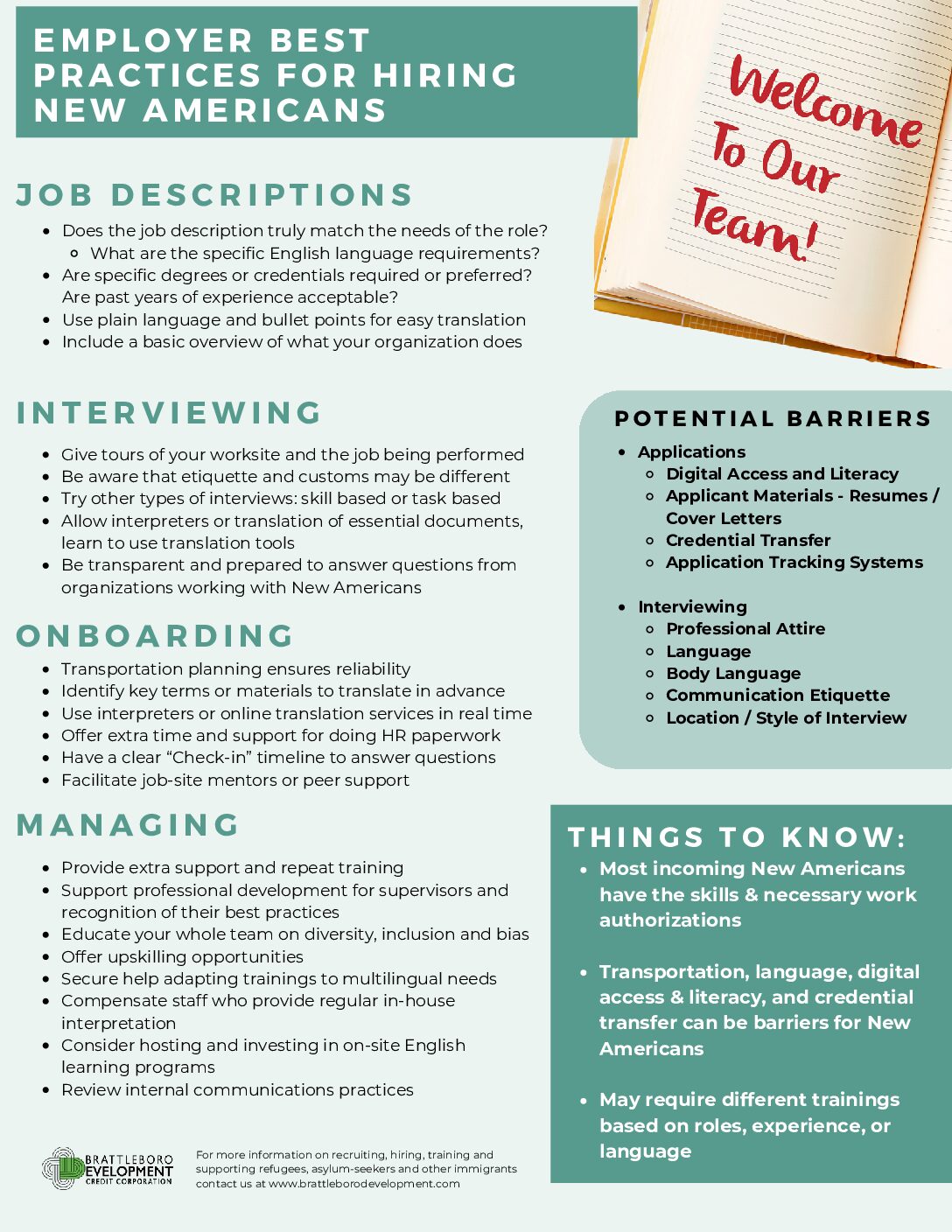
Download this simple guide to get started!

Refugee Resettlement – Background

The Brattleboro Development Credit Corporation (BDCC) identified increased immigration to the region as part of its federally approved, 2014 Comprehensive Economic Development Strategies (CEDS). Starting in 2019 BDCC began convening regional partners to help design and implement immigration systems-building, now working under the banner of, Welcoming Communities.  Members of this coalition, led by BDCC recently received funding under the Boston Fed’s Working Communities program sponsored by legislation proposed by Governor Scott and approved by the Vermont Legislature in 2021 to implement an expanded program across Southern Vermont.

The focus of the Working Communities project is long-term system building in support of Immigrants and historically disadvantaged populations in the Southern Vermont.

In addition to the long-term systems building for SoVermont, BDCC is providing Windham specific leadership in helping employers prepare their operations to be Welcoming Workplaces.  BDCC is gathering resources and leaders experienced in creating educational materials to assist employers ready their existing workforce to work alongside individuals for whom English a not their primary language, to learn about and explore their known or unknown biases to ensure each and every employer in Windham Region is welcoming.

BDCC is working with the Ethiopian Community Development Council (ECDC) who is the region’s designated Refugee Relocation service provider, responsible for all relocation services under the federal relocation program.  ECDC works under a community sponsorship model in which they ask for local community members to form a team and sponsor individual households during their initial 90- days of residency and beyond.  ECDC supports the intensive federal and state paperwork during the initial intake and procures temporary housing until a sponsorship group is identified and connected to a newly arrived household.  Once the sponsorship group procures housing, furnishings and other essentials, the individual can relocate.  ECDC also assists individuals through required federal and state process for work eligibility.  Only individuals approved can seek employment.  Individuals may work for anyone, anywhere they choose.  BDCC and ECDC hope that individuals find employment with employers who understand the challenges and supports necessary for lasting employment.

The current workforce supply and demand strongly favors the worker, currently most refugees are accepting positions for wages not less than $16 per hour.  Any employers considering hiring refugee workers are encouraged to consider the market forces at play in refugee’s consideration of their options.  Additionally, the availability of convenient and timely transportation to and from work and the proximity to their home will play a strong roll in their decisions.  Have jobs available where no refugees live?  You may consider working with ECDC to form a community sponsorship group to help find local housing and transportation solutions.

* Some interpretation and translation may be provided, based on availability and need. However, employers should plan for these needs. Immigration partners can help find local interpreters for employers to hire directly in some cases. ECDC also uses and recommends the services of BoostLingo.  SIT World Learning recommends Tarjimly which works very well and has a no cost version.